
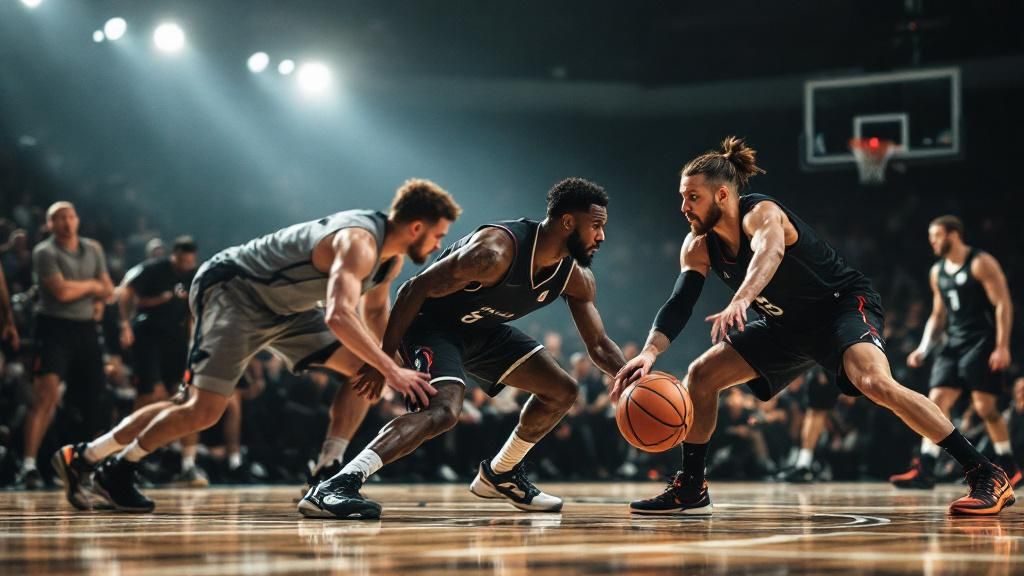
The pick and roll remains one of basketball’s deadliest offensive asset, yet only the world-class point guards truly master its complex nuances. From Stephen Curry’s elite spacing to Luka Dončić’s inventive finishing, the top playmakers command this fundamental play with outstanding sophistication. This article explores the sophisticated methods that set apart championship-calibre playmakers from the field, assessing how elite point guards exploit defensive schemes, create scoring opportunities, and maintain competitive dominance through polished pick and roll application at the top tier.
Understanding the Core Principles of Pick-and-Roll Play Mastery
The pick and roll exemplifies basketball’s most fundamental yet profoundly effective offensive action, acting as the cornerstone of contemporary offensive strategy at elite levels. Mastering this two-man game demands exceptional understanding of positioning, timing, and defensive recognition. Elite point guards understand that successful execution surpasses simple mechanical repetition; it demands nuanced interpretation of defensive positioning and instantaneous decision-making. The elite operators employ the screen and roll not merely as a scoring tool, but as a multi-purpose weapon for producing gains that extend across entire offensive systems, creating secondary opportunities for fellow players and prompting defensive adjustments that uncover defensive gaps.
Championship-calibre point guards set themselves apart through their capacity to control pick and roll variables with exceptional accuracy and inventiveness. They understand that screen angles, roll timing, and decision-making speed critically shape outcomes against sophisticated defensive schemes. Understanding defensive coverages—whether switching, hedging, or blitzing—allows elite playmakers to anticipate opponent reactions and capitalise on openings accordingly. The basis of success lies in acknowledging that the pick and roll’s true power emerges from blending technical skill with game understanding, enabling point guards to direct offensive play with command and regularly produce high-quality scoring chances that maintain a winning edge throughout demanding seasons.
Optimising Layout and Placement Approaches
Elite point guards recognise that spacing and positioning create the foundation of effective pick and roll execution. By keeping proper spacing from teammates and the ball handler, guards create passing lanes that defenders struggle to defend. The most skilled playmakers set up to expose defensive vulnerabilities, driving defenders into awkward movements. This tactical understanding allows them to anticipate defensive shifts milliseconds faster than their opponents, enabling accurate decision-making that separates elite performers from solid players in demanding high-stakes settings.
Positioning extends beyond basic floor positioning; it involves forecasting defensive adjustments and modifying tactics. Elite point guards constantly evaluate court spacing, identifying how their placement affects scoring outlets and scoring opportunities. By orchestrating subtle movements and maintaining awareness of all five defenders, elite guards control court spacing to create advantageous matchups. This sophisticated approach to positioning converts the pick and roll from a simple offensive action into an effective offensive weapon, permitting teams to regularly produce efficient scoring chances against even the toughest defensive schemes.
Advanced Decision-Making and Reading Defensive Strategies
Elite point guards distinguish themselves through outstanding defensive reading capabilities during pick and roll situations. These playmakers instantaneously recognise whether defenders use switching tactics, blitzing, or defensive adjustments, then capitalise on weaknesses with surgical precision. By studying defensive tendencies in advance and reading real-time adjustments, championship-calibre playmakers consistently locate open teammates or generate advantageous scoring situations. This mental processing happens in milliseconds, converting the pick and roll play into a chess match where superior intelligence prevails over defensive schemes.
The most skilled point guards create complex analytical systems for choices within pick-and-roll scenarios. Rather than fixed responses, they leverage fine-grained situational indicators—defensive placement, player spacing, and when help arrives—to establish optimal outcomes. Understanding when to drive to the basket, when to feed the big man, or when to restart the offence separates elite creators from capable operators. This adaptability troubles defensive coordinators, as their schemes become predictable against truly exceptional playmakers who regularly refine their reactions.
Mastering advanced pick and roll techniques ultimately demands cultivating basketball’s premier intellectual requirement: analysing defensive strategies with intuitive precision. Championship floor leaders transform millisecond observations into title-clinching actions through dedicated training, film study, and game-level exposure. This combination of tactical proficiency, athletic ability, and cognitive sharpness establishes championship calibre, enabling point guards to regularly outsmart opponents and generate continuous performance excellence at the sport’s elite level.
